

One of the dynamics I’m starting to think a lot about regarding American politics is that Republicans have more kids than Democrats. When a political coalition consistently has significantly fewer children than its opponent, sustaining that coalition over time seems like it could potentially be a bit difficult to me, so let’s dig in.
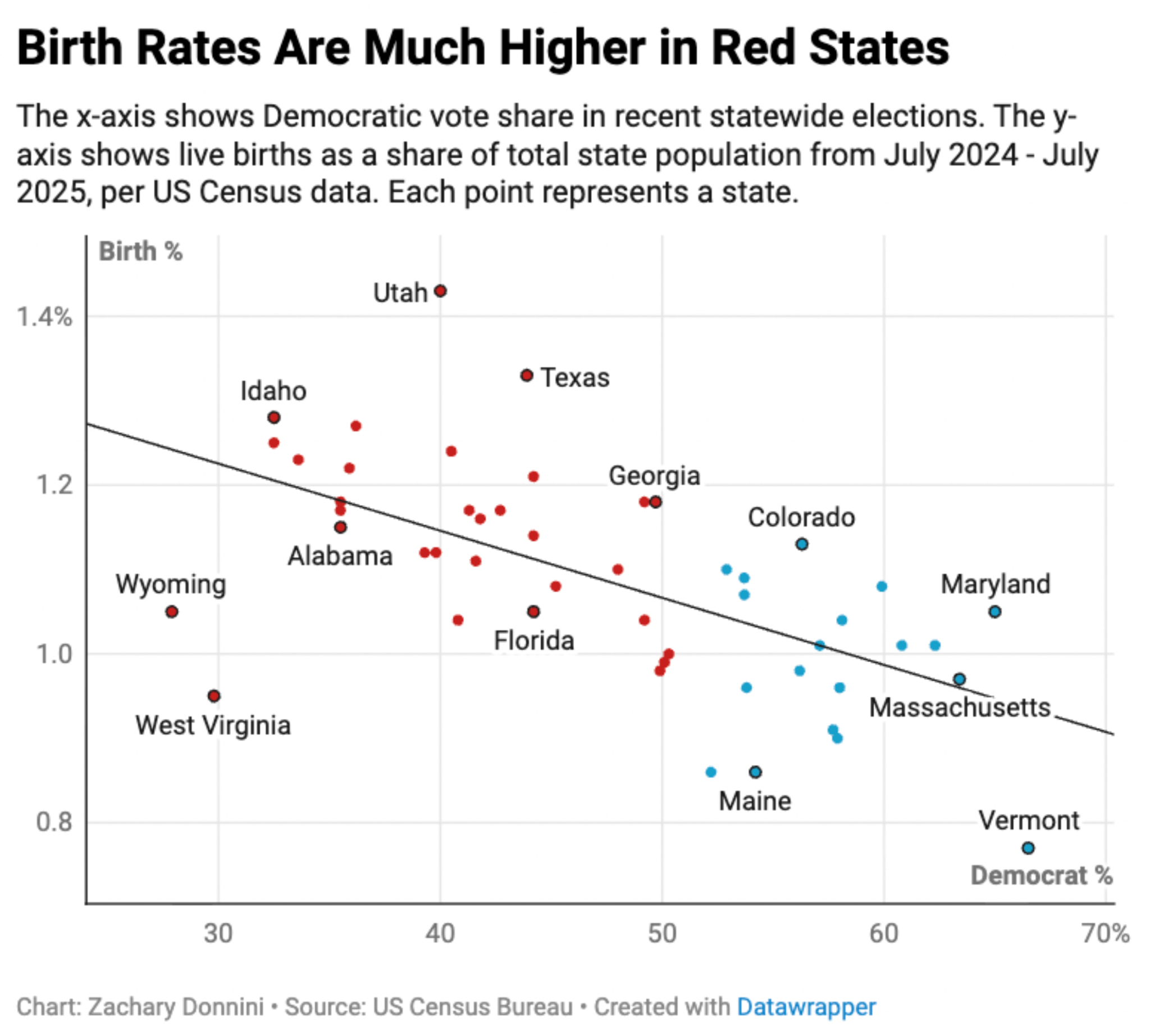
I’m well aware that state-level data is not always the cleanest unit of analysis, and I would not present a plot like this and imply it’s evidence of an individual-level relationship without more granular data to support it. That said, with the release of the new 2025 U.S Census Bureau population estimates this week, it’s worth noting that fertility rates in Republican-leaning states are substantially higher than in Democratic-leaning states. The relationship is pretty strong. The correlation between Trump vote share and fertility at the state level is now 0.84, up from 0.79 last year, which is unusually high for demographic data of this kind.
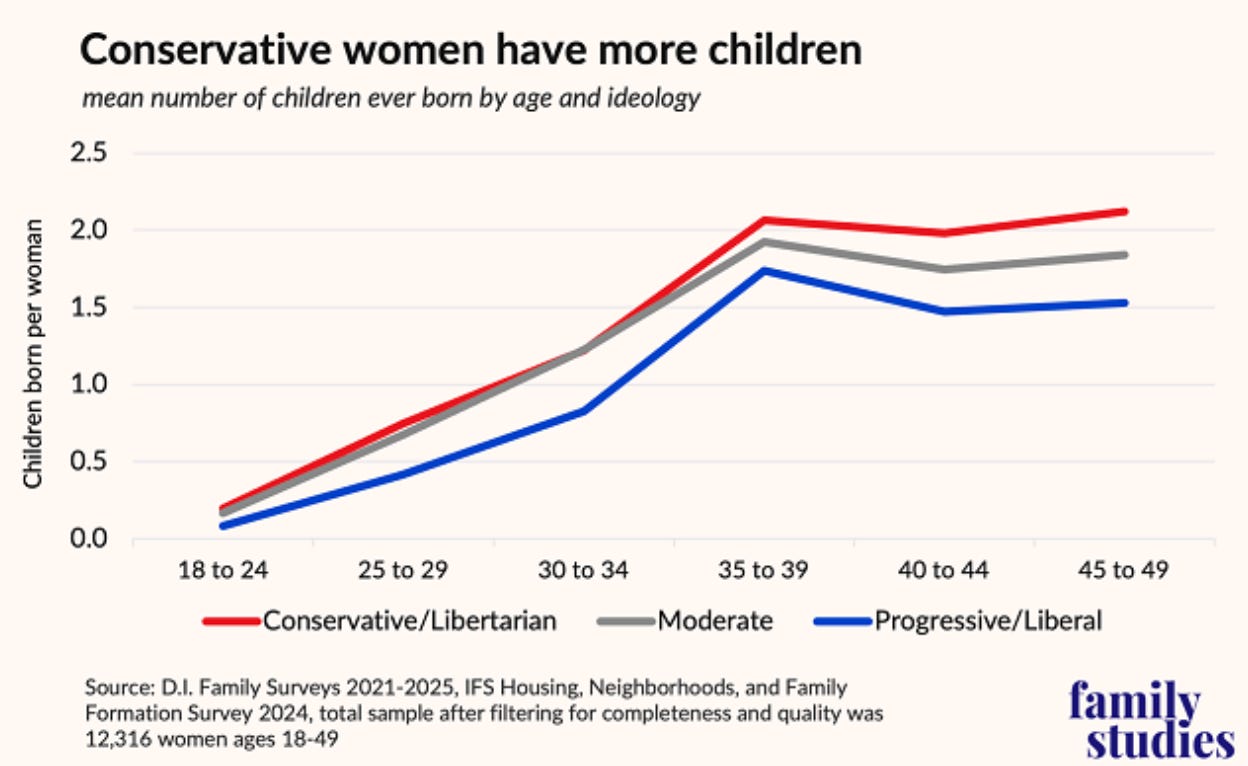
At a high level, the gap reflects systematic differences in family formation between conservatives and liberals. Conservative women end up having more children than liberal women, but why? Upstream, they report wanting more children, are more likely to marry, and conditional on marrying are even more likely to marry at younger ages. Since married women have significantly higher fertility than unmarried women, and conservative women are more likely to be married at nearly every age, these patterns compound over time.
The underlying drivers of these trends and preferences to me are not especially mysterious. Much of this appears downstream of the long-running divide between feminist norms and family-centered values. Liberal women, on average, are now very, very likely to embrace the idea that fulfillment should be defined independently of their “traditional” role of marriage and motherhood, a view that has become increasingly dominant in the last half-century. It is therefore not surprising that young liberal women, having internalized these norms, place less value on marriage and childbearing, marry at lower rates, and ultimately have fewer children. This outcome seems like a fairly natural consequence to me of stated preferences and social incentives. There is good survey evidence supporting these dynamics, including some recent polling work from NBC and this cool poll on dating from Daniel Cox.

But you say, “This partisan fertility gap is not new. Feminism and its downstream cultural effects have been shaping family behavior for decades, and the divergence between liberal and conservative fertility has been visible for roughly 30 years. So why does this dynamic feel as though it is coming to a head now? Couldn’t you have written the same piece ten years ago?”
Good question. The key change this year that really is blowing my mind isn’t really related to anything I discussed above. For many years, higher fertility among Black women helped offset lower fertility among White liberals, which mattered electorally because Democrats have historically won overwhelming margins among Black women across ideological lines. That buffer is now eroding rapidly as Black fertility rates declined sharply in 2025 while White fertility rate actually increased. This data is preliminary and subject to revision, but if it’s real and this decline persists, it poses a meaningful problem for Democrats. For much of the past several decades, generational churn has been relatively favorable to Democrats: conservative fertility exceeded liberal fertility, but Millennials were overwhelmingly liberal, and higher Black fertility rates helped offset the partisan birth gap.
That equilibrium appears to be shifting. Gen Z is currently far more conservative than Millennials, though that could certainly change. At the same time, Black fertility rates are declining relative to White fertility rates. If those two trends continue in parallel, the demographic dynamics that previously cushioned Democrats against lower overall fertility among White liberals may no longer operate in the same way.
Taken together, this creates a genuine long-run challenge for Democrats. Children tend to inherit their parents’ partisan leanings at meaningful rates, and Republicans are having more children than Democrats. And that gap is widening, not narrowing. Sustaining a competitive political coalition becomes more difficult when one side is, quite literally, not replacing its voters over time.
Also, while in equillibrium the national partisan strength will remain roughly 50/50 in EQ, it seems likely that trend this may push the median voter, and thus the parties, rightward.
Great data Zach!