

March is here, which means it’s time for my annual article that has nothing to do with politics or demography.
So why should you listen to my bracket advice? Over the last three years, I’ve made about $5,000 in net profit on bracket pools. I typically enter a handful of pools and spend around $300–$400 total each year on entry fees, so it’s been a pretty good run. Some of that is definitely luck. Even if my models were perfectly calibrated, I’d only expect to earn around 3–4x my entry fees in a typical year in revenue. Over a three-year period, that would usually come out closer to $2,500 in profit, not $5,000. So the recent results mean I’m on a bit of a heater.
But the underlying idea is still sound. If you follow the strategy in this guide, you should have a real edge in most bracket pools. In smaller pools, that edge is modest but fairly consistent. In larger pools, the strategy gets more aggressive—you’ll win less often, but your expected winnings edge is greater, as you can differentiate effectively through high-variance strategies.
Table of Contents:
Section 1: Math Thoughts
Section 2: Basketball Thoughts
Section 3: Algorithm Ranking and Ratings
Section 1: Math Thoughts
Key fact: The bigger your pool is, the more risk you should take.
This section applies to brackets every year and is mostly copied and pasted from last year.
First, understand the math of brackets. To maximize your chances of winning your pool, you need to do two things: pick good teams that are likely to win and differentiate yourself from the rest of your pool (especially in the later rounds). Differentiation matters a bit in earlier rounds too, but it’s usually smarter to pick “chalk” (the favorites). The goal is to pick up points where others lose them. You’re better off finishing first or last than somewhere in the middle.
Next, consider the size of your pool. The larger the pool, the more risks you should take to differentiate yourself. In small pools (fewer than 25 people), it’s often best to pick mostly chalk, perhaps deviating slightly with your title pick. In mid-sized pools (around 100), you’ll still want to stick with a lot of chalk, with maybe a single deviant pick in the mid or later rounds. Once you get above 100, having some lower-seeded teams in the Final Four starts to make more sense.
The pool’s scoring system is also key. In seed-bonus pools, where you get a bonus for picking lower-seeded teams to win, take advantage of that by picking strong double-digit seeds in the first two rounds. However, you should still pick a top seed to win the title. In flat-scoring pools (where the point structure is something like 1-2-3-4-5-6 instead of 1-2-4-8-16-32), picking chalk in the later rounds is crucial since differentiation is less important. Focus on accuracy, with a little differentiation in the early rounds.
(The rest of the general advice is for people who take this more seriously—skip to the next section if you’re getting bored.)
How “sharp” your pool is also matters. If you’re in a casual pool with friends, family, or work colleagues, it’s fine to pick trendy teams, such as teams with strong traditional (KenPom) analytics profiles for their seed. But if you’re in a sharp pool with more serious players who will be looking at analytics and think they know basketball, you want to turn the tables on them and avoid those trendy teams.
My competitive edge comes from looking beyond surface-level “efficiency” analytics to uncover the deeper stories behind why teams may outperform or underperform their statistical profiles. The #1 most important consideration is to view college basketball as a small-sample exercise in a Bayesian world. We start with priors—such as the preseason AP poll and KenPom rankings—and update them based on in-season results. Many analysts mistakenly rely 100% on the data (season results), ignoring the importance of incorporating priors into their posterior beliefs about team strength. That approach throws away valuable information.
This concept is fundamental to how you should view NCAA brackets. It might seem like one of those spurious correlations you should ignore, but it’s actually rooted in a sharp Bayesian understanding of college basketball. The streak will eventually end, and I suspect it matters less than ever anyway. In the NIL and transfer portal era, preseason expectations carry much more uncertainty. Still, it’s an important concept to understand.
This also extends to conference strength. Teams from conferences that were stronger than expected during the regular season (which isn’t really the case for any conference this year) tend to underperform in March, while teams from conferences that were weaker than expected (like the Big East) tend to overperform. The reason? Cross-conference results early in the season provide only a small sample of data, and failing to account for the importance of the prior can lead to misjudging team strength.
Other key factors I consider:
Health: Are there teams that struggled with injuries but are finally healthy?
Experience vs. Talent: Have highly talented but less experienced teams improved significantly over the past two months?
Fake Team Strength: Did some teams inflate their efficiency metrics by dominating weak opponents while struggling against tougher competition?
Key Absences: Are there teams missing a key player due to injury who won’t return?
Rotational Changes: Have lineup adjustments significantly altered a team’s performance?
Matchups: Does a team have an especially favorable or unfavorable draw?
Opponent Shooting Variance: Have opponents hit an unsustainably high or low percentage of jump shots or free throws?
Team Shooting Variance: Are there players with a proven track record struggling this year but improving late?
Finally, for the tiebreaker score, a good rule of thumb is to enter 144 (e.g., 76–68), which is considered the optimal total. If your title pick is a high-scoring team like Michigan, Arizona, or Florida, adjust the total upward. For lower-scoring teams like Duke, Iowa State, or Houston, adjust it downward. The tiebreaker matters, especially in large pools. A massive proportion of winning outcomes will come down to tiebreakers. Don’t overlook it.
BASKETBALL SECTION
The 1 seeds are really, really good this year (especially Duke, Michigan, and Arizona). Unfortunately, the NIL era has led to more dominance at the top and fewer upsets in March. That doesn’t mean this year will be as boring as last year, where basically all the favorites won, but it does mean the underlying analytics for the top seeds are the strongest I’ve ever seen relative to the field.
Title Favorites
Duke (1 seed, dislike)
Duke is widely regarded as the best team in the country, and they had a great year. They are very good and are led by the best player in the country, Cameron Boozer.
Losing Caleb Foster to a broken foot against UNC on March 7 will dominate my analysis of this team. Foster should be out until at least the Final Four, and potentially for the entire season. Without Foster, they not only lose his 25 MPG and 9 PPG, but also the floor spacing he provides. Duke only had eight good players (with Foster), and his loss will probably force them deeper into their bench and into playing Darren Harris more, who isn’t very good.
This Duke team’s biggest (arguably only) weakness is three-point shooting, and without Foster they’re going to have to rely on guys like Dame Sarr and Nikolas Khamenia to make shots. Stud center Patrick Ngongba also sat out the last few games of the year and has been ruled out for the first NCAA Tournament game, and although the injury isn’t expected to be serious, it is still concerning.
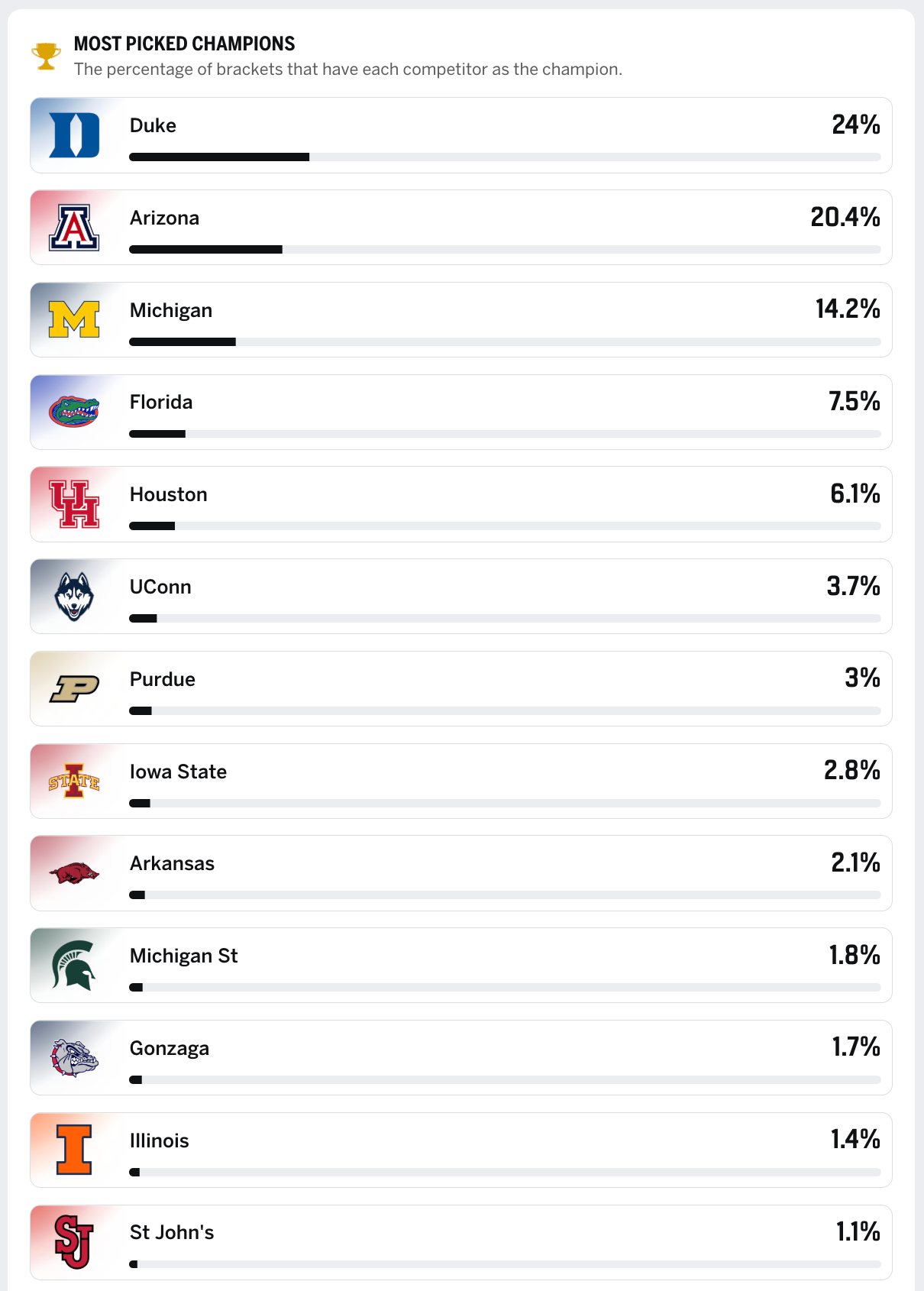
Duke is really good, and arguably the favorite to win the title in my head, but the issue is how many people are picking them. It’s hard to win pools when you’re picking a team that a huge portion of the field is also picking that isn’t even clearly the favorite. I think the Foster injury is a pretty big issue.
Michigan (1 seed, like)
Michigan is also really good and dealing with an injury of their own. Backup guard LJ Cason tore his ACL against Illinois. However, I’m less concerned about this injury for two reasons: (1) Cason’s injury leaves Michigan with eight strong players (compared to seven for Duke without Foster), and (2) Cason is more of a redundant piece than Foster.
Michigan does now only have a single lead guard in Elliot Cadeau, but he can play ~30 MPG, and the team has been fine without either Cadeau or Cason on the court this year. Trey McKenney, Roddy Gayle, and Nimari Burnett can all handle the ball some, and Yaxel Lendeborg is an elite passer.
Another thing that works in Michigan’s favor is how good their draw is. Their 5 seed Texas Tech lost JT Toppin for the year to a torn ACL, and their 4 seed Alabama had their second-best player Aden Holloway arrested and charged with a felony for being a drug dealer on Monday (oops).
Michigan’s analytics were, if anything, actually slightly stronger than Duke’s this year. And I believe the Cason injury is less of a big deal than the Foster injury. They did close the season really poorly, which makes you think the Cason loss might be a bit of an issue. Still, the public is really out on them. Michigan is my favorite national champion pick this year in small pools.
Arizona (1 seed, like)
Arizona is a really good team with only two losses against a tough schedule this year (and one of those came with star Koa Peat injured, which is nice). They don’t have the most talented roster ever, but they have good players and are very strong defensively across the board.
This team is very, very good, and they are healthy—unlike Michigan and Duke. A lot of people are picking them to win the title, but I still think picking them to win is a very reasonable play, especially in small pools.
Florida (1 seed, like)
Florida is a bit of a conundrum. They started the season poorly, then had a very strong second half, before getting completely ripped to shreds by Vanderbilt in the SEC Tournament.
The defending champs return their entire frontcourt from last year, and it’s elite. They also spent a lot of money on elite guards Xavian Lee and Boogie Fland, who are solid all-around players but seem to have forgotten how to shoot the basketball this year. Lee has been a pretty big disappointment but has been playing better as the year has gone on, which you could interpret as adjusting to a higher level of basketball.
If Florida makes shots, they can win the title. The public really hates them, which is surprising given they are the defending champs and a 1 seed. Either way, they are undervalued. I think it shows how overvalued Duke is that I think all three of Michigan, Arizona, and Florida are good title picks.
Houston (2 seed, like)
Houston is pretty much just as good as a 1 seed Florida, especially after considering the added bonus of getting to play their Sweet 16 game (potentially against Illinois) and their Elite 8 game (potentially against Florida) at home in Houston. This is pretty ridiculous, and the NCAA should be embarrassed about it. However, the public is really really in on Houston this year and people are picking them a ton to go to the Final Four. Illinois is the value play to the Final 4 in larger pools in this region, while all three of Houston, Florida, and Illinois are being underrated in their chances to make the title game.
Other Teams
Iowa State / Illinois (2/3 seeds, like)
ISU and Illinois are the only truly “viable” title picks in pools under 500 people outside of the top 5. Purdue is also roughly as good as these teams (deep down I think they’re better), but a lot of people are picking them.
ISU and Illinois both have good early-round draws (Illinois gets UNC in the second round, who is very weak, while ISU’s 3 seed Virginia is very weak), are very solid teams (probably the 6th and 7th best teams in the country), and are being underpicked by the public.
If anything, I’m probably lower on both teams’ chances to win than basketball sharps are (especially Illinois, whose “matchup-hunting” offense has allowed them to post some really gaudy efficiency ratings but has also made them perform worse against better teams relative to weaker teams for three years in a row now—I don’t think that’s a coincidence). Illinois’s best path to a title is to take care of business against weaker teams and hope for chaos. But people filling out brackets just aren’t picking ISU and Illinois as much as they should, meaning they are title-winning options in 150+ person pools and can go to the Final Four/Title Game in ~100 person pools.
Purdue (2 seed, meh)
I wrote a section saying I really liked Purdue before they won the Big 10 tournament last weekend and got hyped up a lot. I still think they are the sixth best team in the country, but they aren’t as good of a value as Illinois and Iowa State.
Purdue has huge depth problems—they have five great players, but Omar Mayer and Daniel Jacobsen have been huge disappointments. I actually view this as a positive in the tournament, where teams tighten rotations. Just like UNC in 2022, I think Purdue will essentially try to play five guys the entire tournament.
Gonzaga (3 seed, ???)
It looks like Braden Huff, probably Gonzaga’s second-best player, is going to miss the first two games, but then has a pretty good chance of returning for the second weekend.
This creates a weird dynamic. They are much weaker early but significantly stronger later. So I both feel the urge to pick against Gonzaga early (if I had to pick one double-digit seed to the Sweet 16 in the entire field, it would be Texas over BYU, then Gonzaga) and also play them to the Final Four or title in very large pools where I want to differentiate with a high-variance strategy—especially against “sharp” players who rely heavily on traditional analytics that aren’t especially fond of Gonzaga.
They are also the worst early round survivor pick imaginable because they get stronger as the tournament goes on.
Wisconsin (5 seed, kinda like)
Wisconsin is the hottest team in the country, oddly without Nolan Winter (their star center) for the last four games. He should be coming back, and I’m optimistic they can keep playing well with him integrated back in.
However, the public is picking them a decent amount, and their draw is tough (Arkansas as their 4 and Arizona as their 1). I’m not especially optimistic about the value in picking Wisconsin deep. I like them, but Illinois, ISU, Vanderbilt, and even UCLA are better options for deeper runs.
Vanderbilt (5 seed, love)
Vanderbilt has the best chance of any 4 or 5 seed to win the title. They have high-end talent and are playing very well recently.
They also have the weakest 1 seed (Florida) in their region, and Nebraska is a weak 4 seed. They can be taken to the Elite Eight in large pools (150+) and even to win the title in massive pools (500+). My favorite true sleeper.
Louisville (6 seed, hate)
Louisville is interesting. They have a very talented roster that has underperformed their ceiling.
They get back Mikel Brown, an NBA-level guard who has missed 12 of their last 23 games. Before his injury, they looked like a 2–4 seed team. I also think Ryan Conwell is due for positive shooting regression and will benefit from Brown taking pressure off him.
However, their traditional analytics profile is inflated by dominating weak competition while struggling against strong teams, which is something I really don’t like to see.
North Carolina, Texas Tech, BYU, Alabama (hate)
The the most important thing to understand about this tournament is what happened to Caleb Wilson (UNC), JT Toppin (Texas Tech), and Richie Saunders (BYU). All three teams lost top-30 caliber players to season-ending injuries.
And then Alabama lost Aden Holloway after he was arrested and dismissed from the team.
All four teams are meaningfully worse than their seed suggests. Alabama vs. Texas Tech, in particular, has turned into a total mess that I’m pretty indifferent toward.
UCLA (7 seed, love)
UCLA has been really good recently and has a great path to the Elite Eight. I don’t think very highly of either MSU or UConn in their region.
Ohio State (9 seed, like)
I really like this team. They’ve improved as the season has gone on and are very talented.
Like Purdue, they have major depth issues, which I actually think helps them in a tournament setting as rotations tighten. Another reason I’m lower on Duke is that I think Ohio State is very, very good.
Specific Earlier Round Picks
2nd Round:
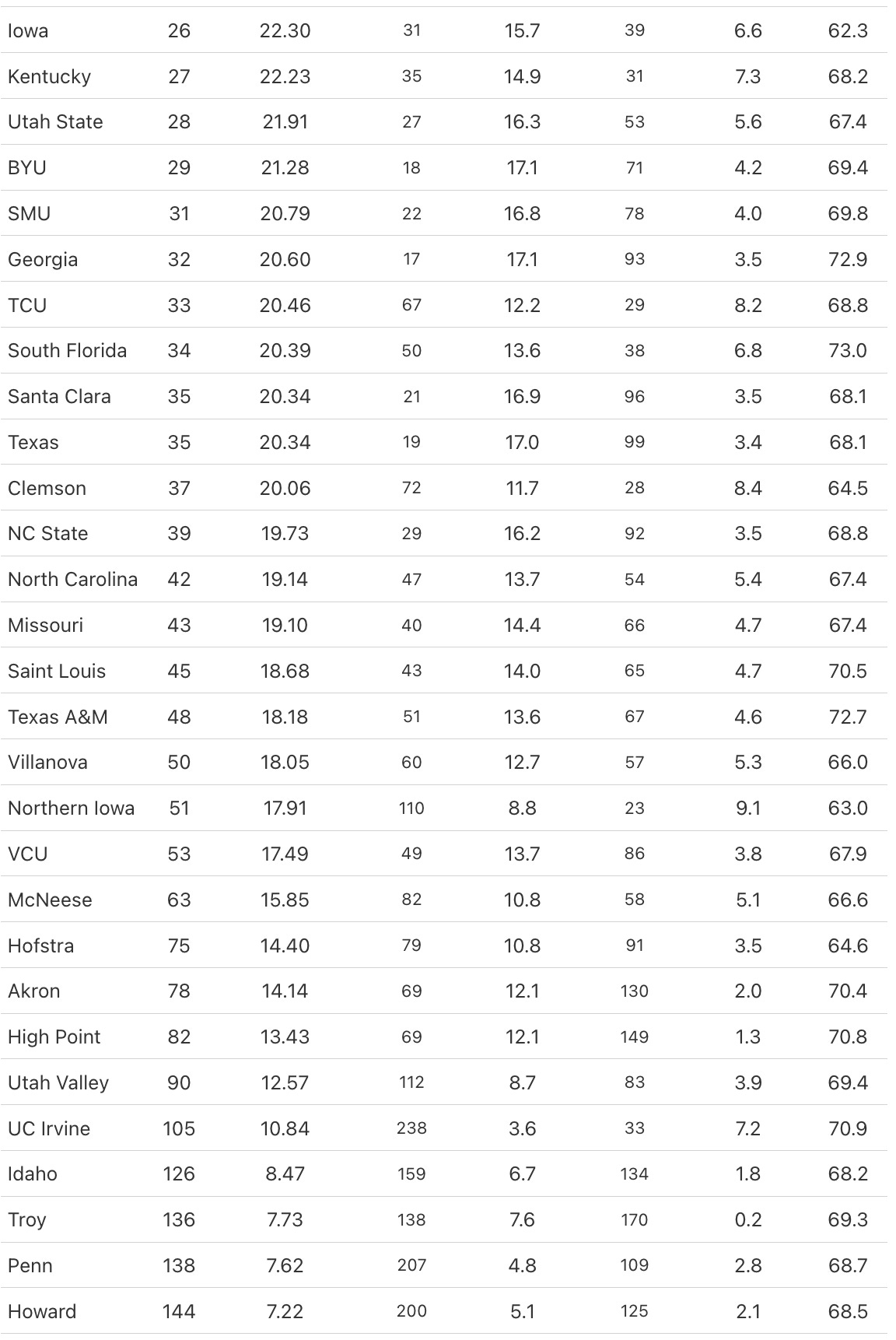
Texas over BYU is my favorite upset. Utah State, Ohio State, Georgia, UCLA, and St. Mary’s are must-picks in my book. Clemson/Iowa I don’t have a strong stance on.
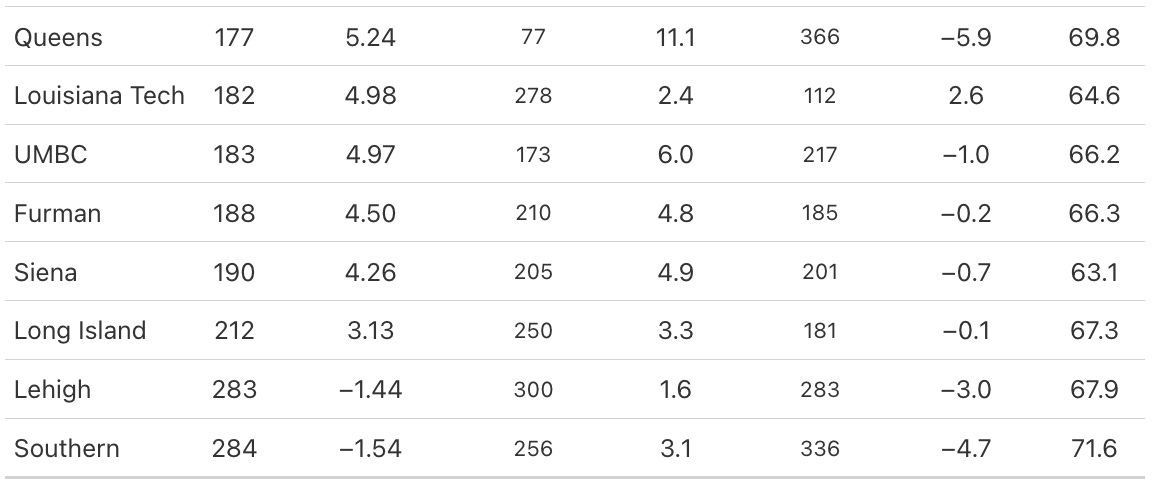
If you want to be a little spicy, I like VCU, Mizzou, and Santa Clara, though they are still underdogs. If you want to be really spicy, I like Northern Iowa and Hofstra (~20–25% win probability).
A lot of people are picking South Florida over Louisville and Akron over Texas Tech, which I actually respect—these are exactly the types of 11/12 games where the underdog wins more often than people expect.
Sweet 16:
It’s a good year for slightly spicy picks in the second round. I do like every 5 seed over every 4 seed in larger pools, but in smaller pools I think you want Arkansas over Wisconsin.
I like UCLA and Tennessee as upset picks in the second round, but mostly in larger pools since they are clear underdogs.
Elite 8:
Not a great year for spicy Elite Eight picks. I like MSU over UConn, but other than that I do really think picking every 1 and 2 seed to the Elite Eight is a must in any pool under 100 people.
In larger pools, I like Illinois and St. John’s (both can make the Final Four). In very large pools (250+), Vanderbilt, UCLA, Tennessee, and Wisconsin are also strong high-variance options.
ALGORITHM RANKING AND RATINGS
Tournament Odds
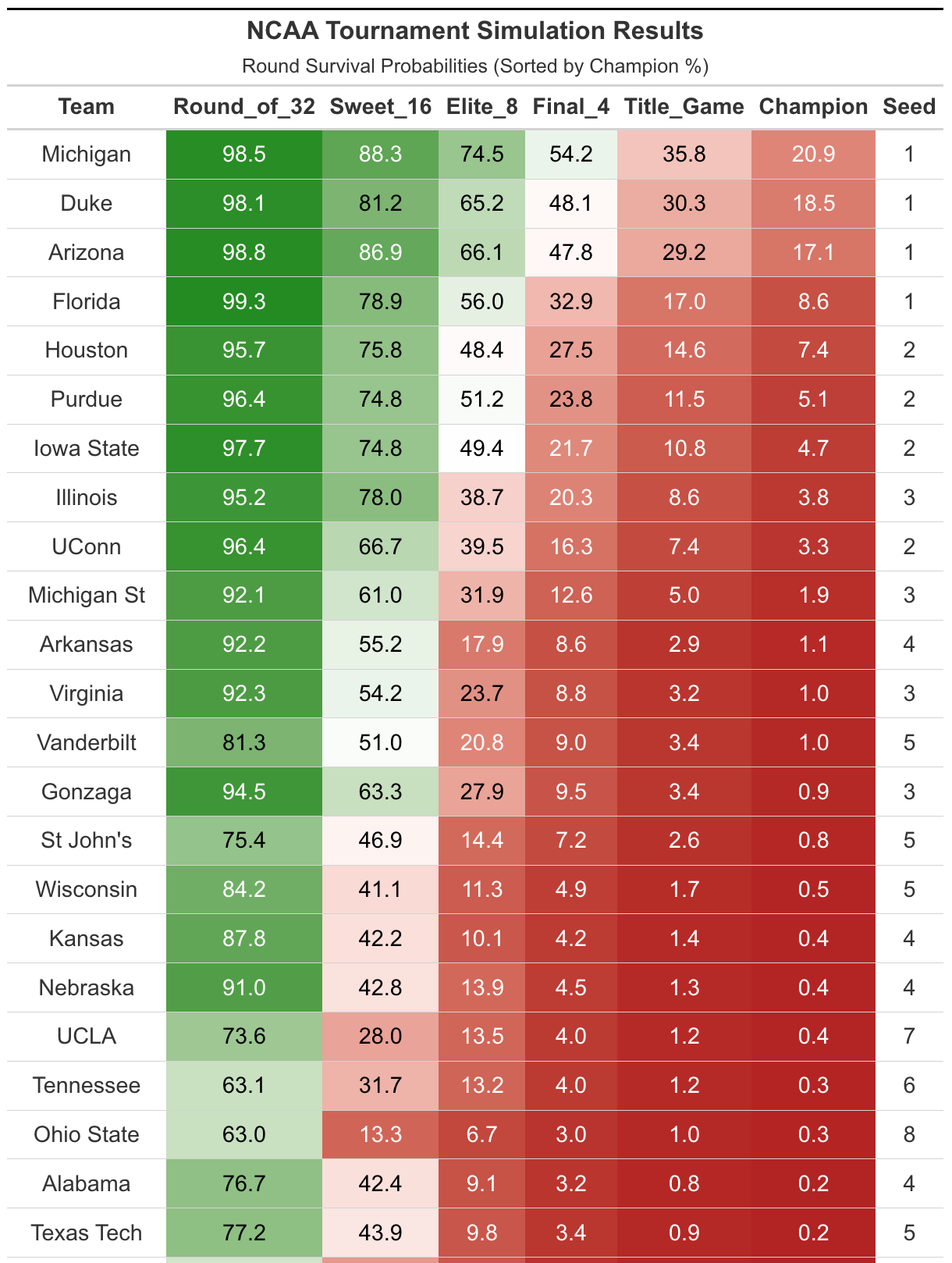
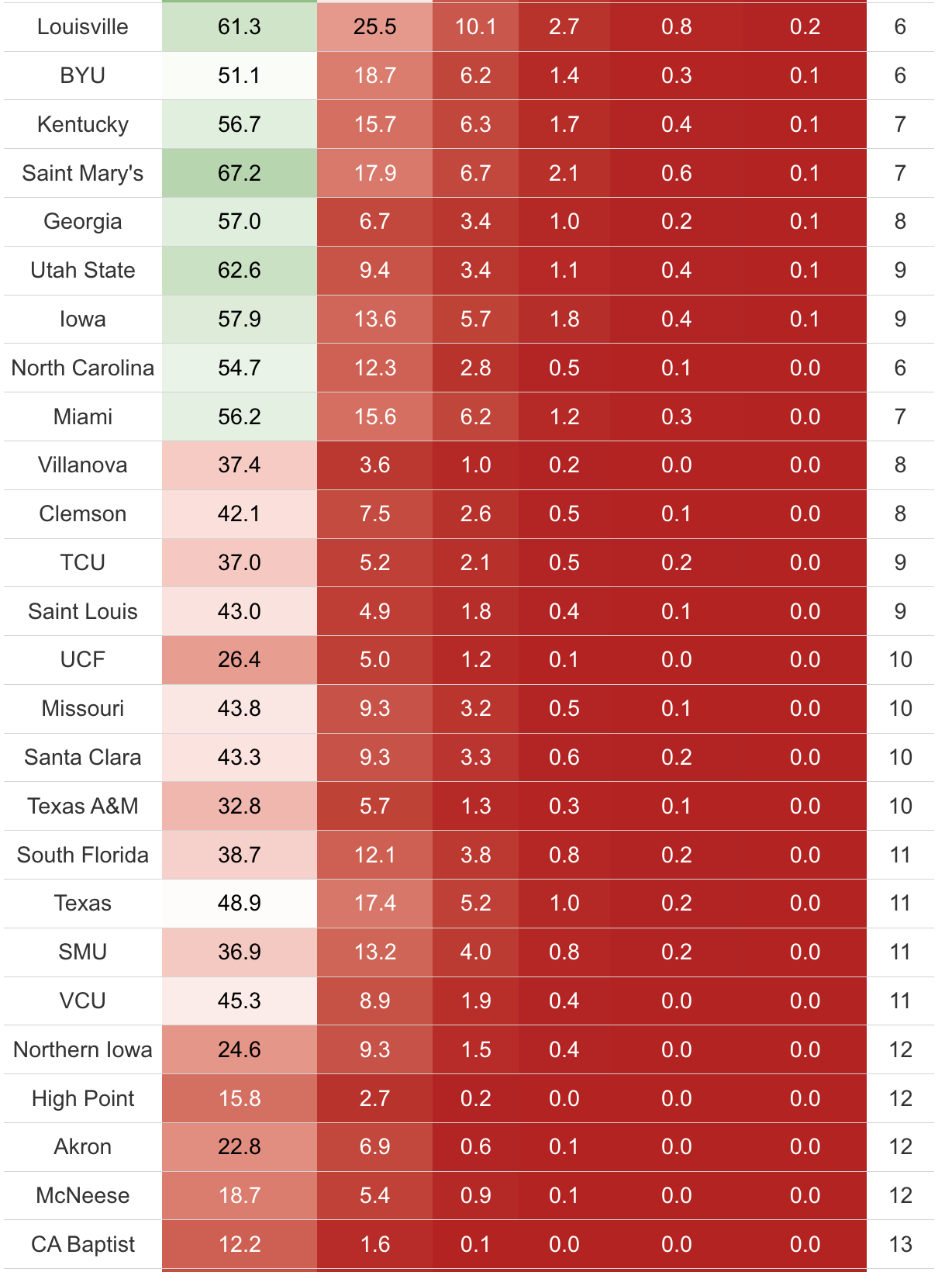
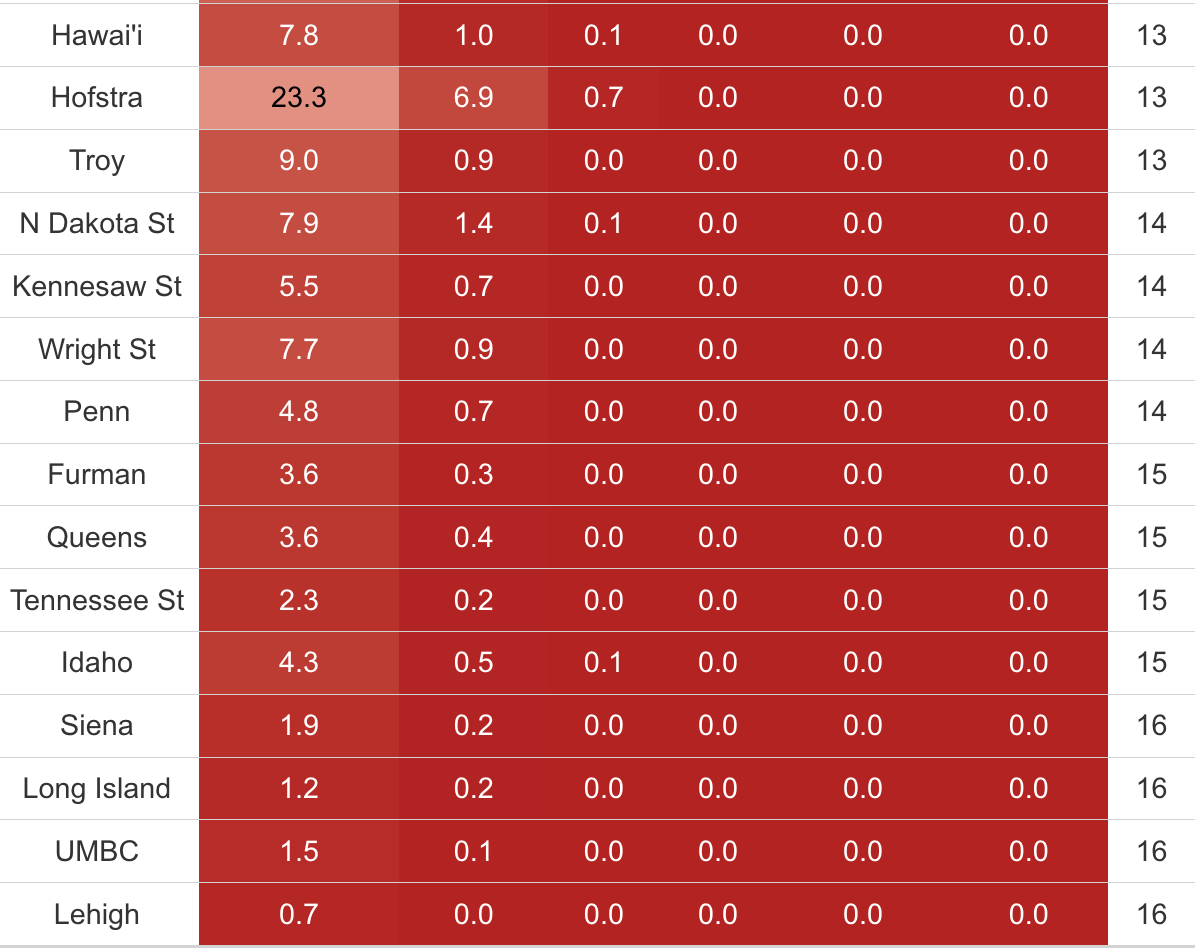
Team Ratings
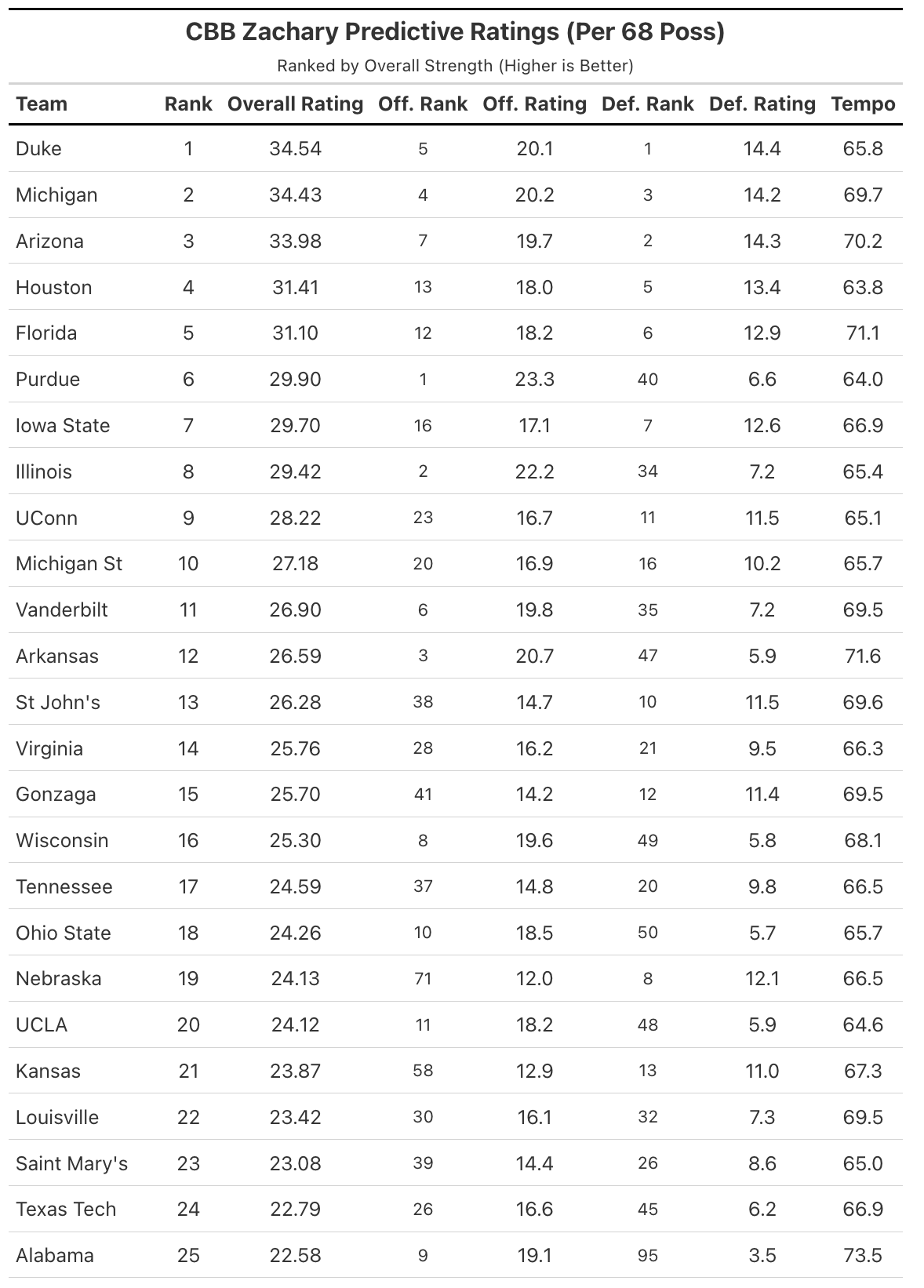
Elite ball knowledge
Just need the people to know I got this info first