

Over the past five years, domestic migration within the United States has followed a clear and consequential pattern: population growth has been consistently stronger in Republican-leaning states than in Democratic-leaning ones.
That pattern is often explained away as a byproduct of geography rather than political factors. Warmer climates, lower density, and suburban or rural lifestyles have long attracted movers, particularly in the Sun Belt and Mountain West. On its face, that explanation is intuitive, but it is incomplete.
Using county-level data, I examined domestic population change while accounting for several of the most commonly cited drivers of migration. I incorporated local climate by collecting average January high temperatures for every county, controlled for development patterns using population density (measured as median weighted census block group density), and accounted for demographic factors. These adjustments capture much of what we would expect to explain migration trends: people tend to move toward warmer, less dense areas, and population change varies meaningfully across demographic compositions.
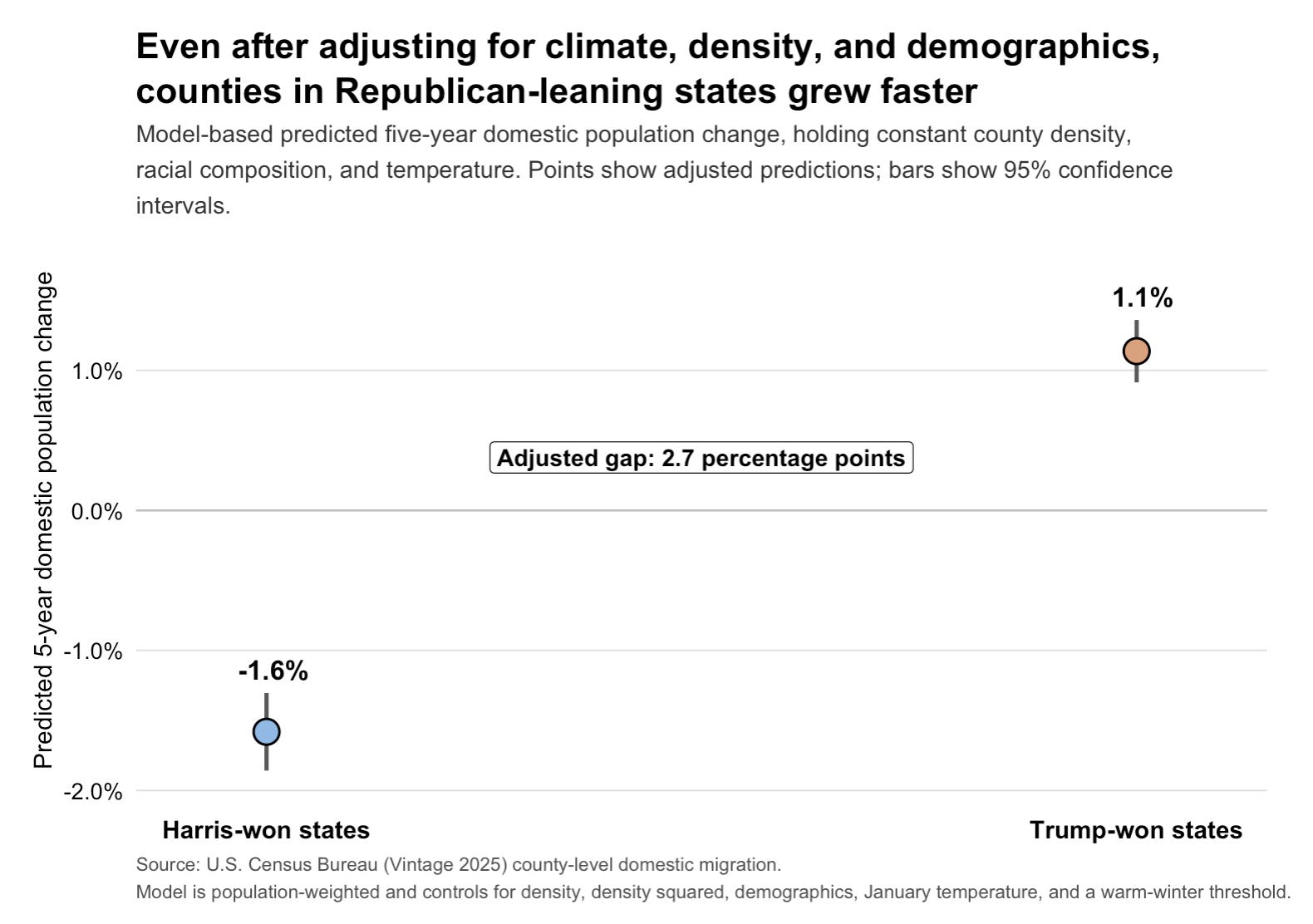
Even after accounting for climate, density, and demographics, a substantial gap remains. Figure 1 shows the model-implied difference: counties in Trump-won states were still predicted to experience roughly 2.7 percentage points more domestic population growth over the past five years than otherwise similar counties in Trump-lost states. That does not, by itself, establish that partisan governance is the cause. But it does suggest that the divergence is not simply a story about warm weather, suburbanization, or demographic composition more broadly.
There is no single agreed-upon explanation. Instead, the debate tends to cluster around a few competing theories.
One argument, often advanced by center-left housing-focused policy analysts, centers on housing constraints. In many Democratic-leaning states, particularly in large metropolitan areas, housing construction has lagged demand for years. Restrictive zoning and local opposition to development have limited new supply, making sustained population growth more difficult. In that framework, out-migration is less a matter of preference than of affordability.
A second explanation, often offered by conservatives, focuses on public safety. Some observers point to differences in crime rates as a potential driver of migration decisions. While there are measurable differences across states, those gaps are more modest than often perceived once demographic and economic factors are taken into account. Even so, perceptions of safety can influence behavior independently of the underlying statistics, and may play a role at the margin.
A third line of argument, also offered by conservatives, emphasizes fiscal policy. Higher taxes and cost of living in certain states are frequently cited as reasons individuals and businesses relocate elsewhere. Whether these factors are decisive or simply contributory remains an open question, but they are consistently part of the broader narrative.
It is difficult to disentangle these mechanisms cleanly, and I do not want to attempt to assign causal weight to any single explanation because it’s not my expertise. What it does establish, however, is that the divergence in population growth between Democratic- and Republican-leaning states persists even after accounting for many of the most obvious structural differences between them.
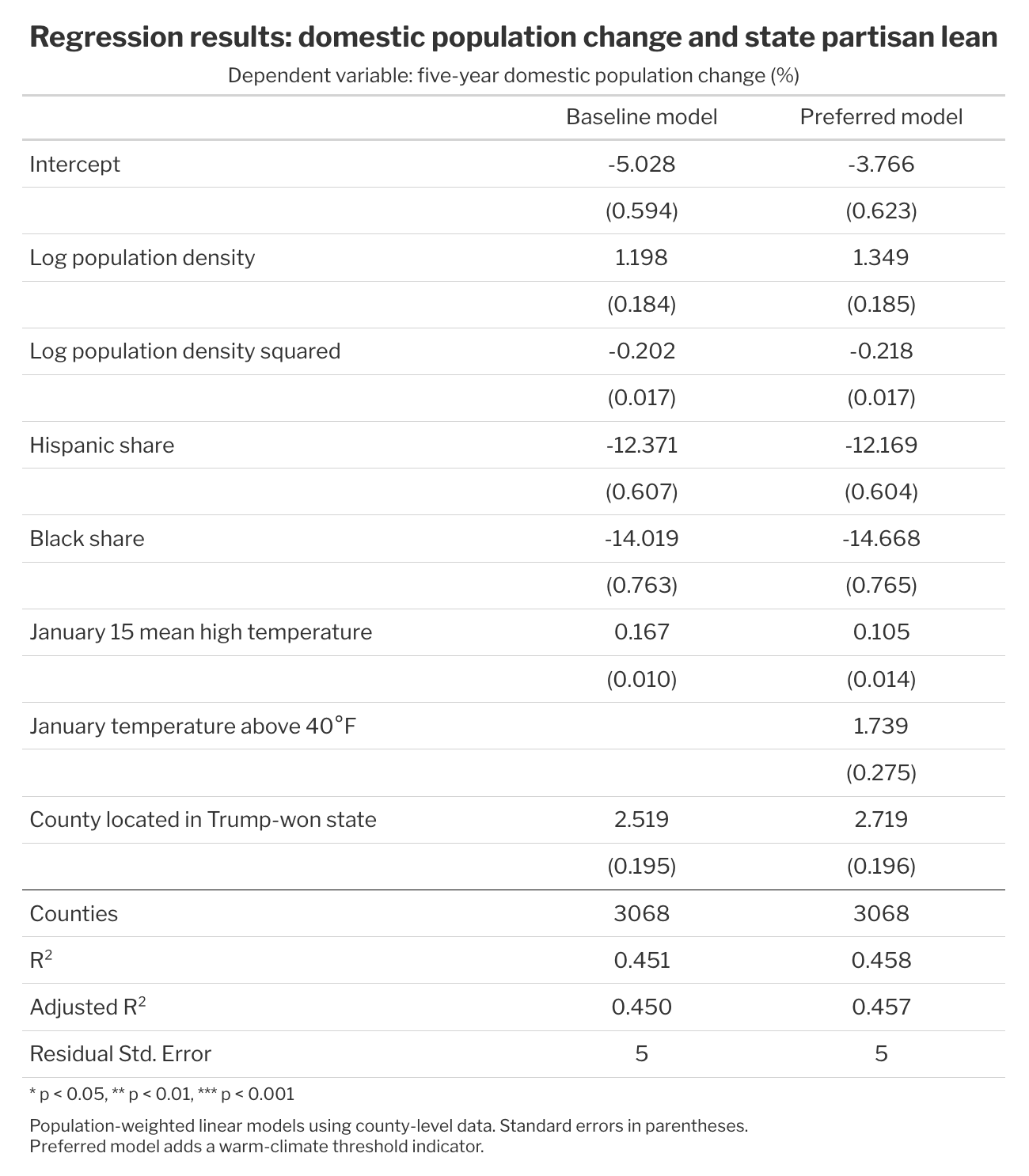
Appendix: Full Regression Results
I plan on moving from NYC to Texas this year. Your explanations 1 and 3 are the main drivers of the move. Explanation 2 is somewhat a factor for me. I would phrase it more as being about disorder and grossness more than public safety. Some other benefits of the move include more access to green space (Austin has lots of parks and green belts) and favorable gun laws.
I believe it also has to do with state and local tax rates as well as remote and work from home job options. Southern states, like Texas and Florida, don't have state/local taxes, so individuals living in those states are getting more money in their pocket.
I was in Florida a month ago, and it turns out that food prices are now increasing to New York levels. So, we'll see some changes there as well. Plus, when you talk about climate, the southern states have been getting more tropical storms (closer to the oceans) and hurricanes and tornadoes. You can imagine insurance premiums being high or no coverage at all for homeowners. So, it may seem like an exodus, but when you take those factors into consideration, I have a feeling, the cost of living in those states will expand.