

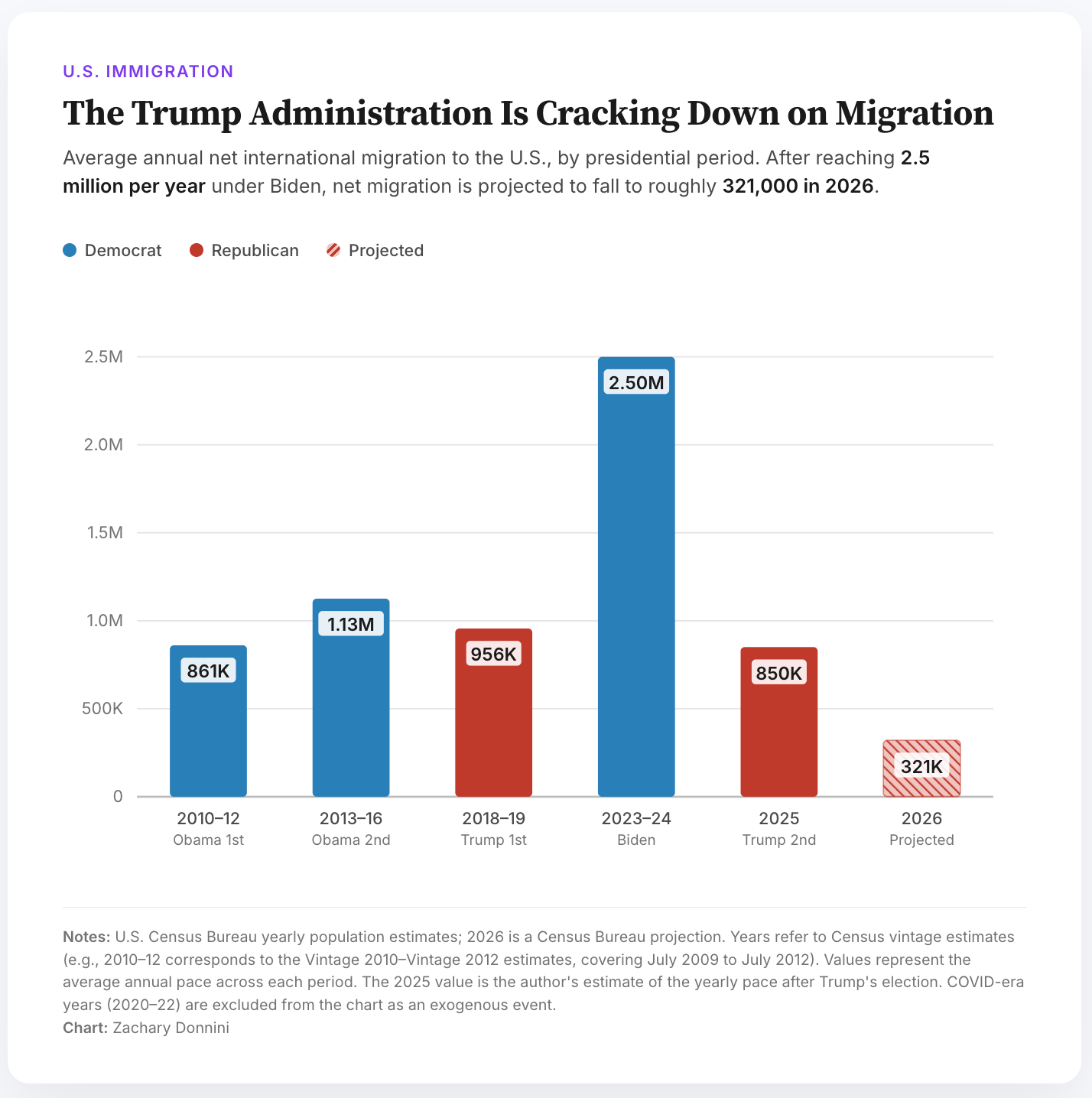
Over the past several election cycles, immigration has become one of the defining issues in American politics. Although President Donald Trump campaigned on more restrictive immigration policies in the 2016 presidential election, net international migration was actually higher in his first term than in Obama’s. After migration rose to unprecedented levels by the end of Biden’s presidency, Trump has followed through on his campaign rhetoric, with his administration implementing a markedly stricter approach to immigration enforcement in his second term. I estimate that net international migration has plummeted to roughly one-third of the levels observed at the end of Biden’s second term. Official U.S. Census Bureau projections already indicate that net international migration in 2026 is expected to be roughly nine times lower than in 2024—an estimate I view as broadly reasonable.
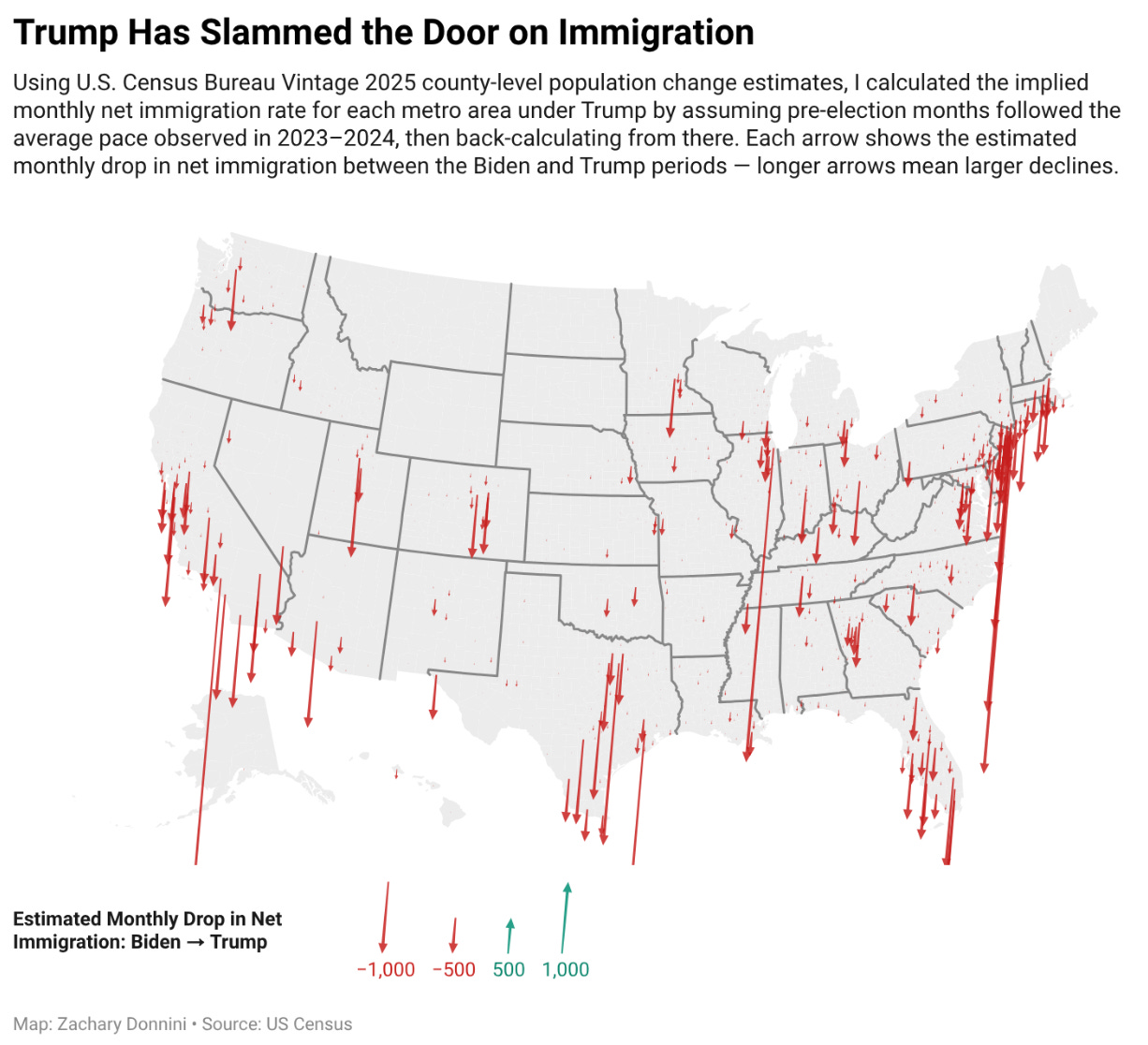
The largest declines in net international migration have occurred in Democratic-leaning urban areas—particularly in California, Chicago, and the Northeast, but also in parts of Texas, Colorado, and Florida. Given that the Census has already signaled that 2030 U.S. House reapportionment may already be unfavorable to Democratic states, a continuation of this trend—where domestic outmigration from blue states is not offset by international inflows—could further exacerbate those losses and frankly make the 2032 Electoral Map pretty scary for Democrats.
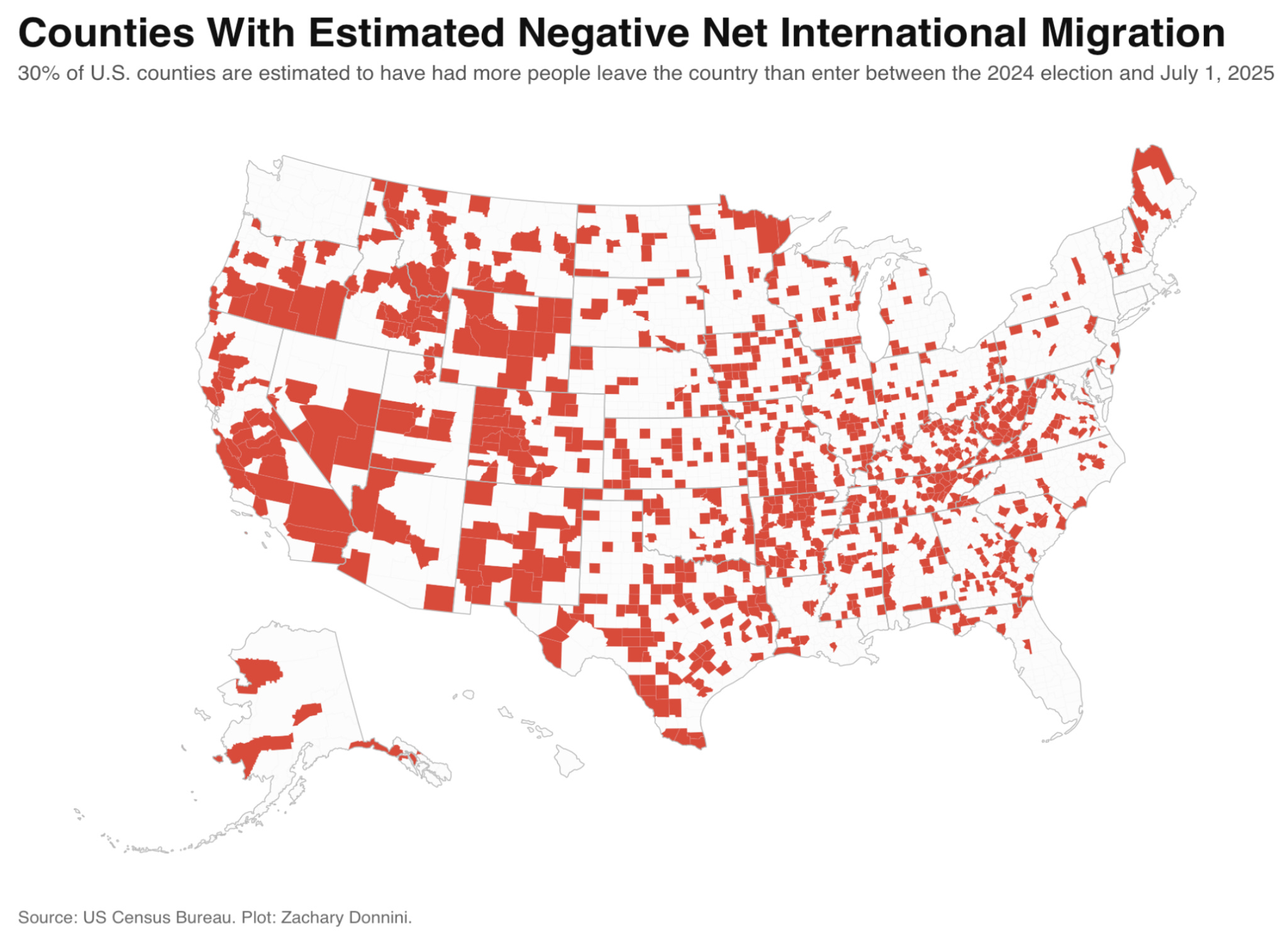
Trump’s administration has implemented a notably aggressive immigration policy, and I estimate that 31% of U.S. counties have experienced negative net international migration. This implies that total outflows—driven by both deportations and voluntary departures (including what is referred to by the Trump administration as “self-deportation”)—have exceeded total inflows, whether legal or illegal. The 15 counties with the largest net outflows are concentrated in predominantly Hispanic communities with high shares of unauthorized immigrants—along the border in California, Texas, Arizona, and New Mexico, as well as in California’s Central Valley.
Data and Methods
The U.S. Census Bureau’s yearly population estimates track net international migration as a single component of population change by county, capturing the net effect of all inflows and outflows regardless of pathway. As a result, shifts in these estimates provide the clearest available signal of how immigration is evolving at a national and local level.
Interpreting that shift, however, requires some care. The Census Bureau measures population change on a July-to-July basis, meaning that the Vintage 2025 estimates reflect a period that only partially overlaps with the current administration. In fact, those estimates include several months that precede both Trump’s 2024 election and his 2025 inauguration.
To avoid understating recent changes, I adjusted for this timing by assuming that migration flows in the three months prior to the election followed the average pace observed in 2023 and 2024, which were broadly similar years. From there, I worked backward to estimate the implied monthly migration rates for the nine-month remainder of the period.
Even under these deliberately conservative assumptions, the results point to a clear deceleration in net international migration. The slowdown appears both widespread and substantial, suggesting that the trajectory of U.S. population growth is already beginning to shift. If anything, this approach likely understates the magnitude of the change. It attributes some pre-inauguration migration to the current policy environment and assumes that any shifts occurred immediately, when in practice such effects often take time to fully materialize.
The more definitive test will come with the next data release. The Vintage 2026 estimates, expected to be released in early 2027, will be the first to capture a full year under current conditions, covering the period from July 1, 2025 to July 1, 2026. I expect a continued sharp decline in net international migration, a view that aligns with U.S. Census Bureau projections.
For now, the early evidence indicates Trump is, in fact, successfully limiting migration. Preliminary estimates suggest that net international migration has fallen sharply, to levels well below those observed in recent years. While it remains too early to draw definitive conclusions about what will happen over the remainder of Trump’s term, the initial data indicate that policy changes are already having a measurable impact on overall migration flows.
This is excellent news!